Introduction
Every contractor, consultant, and service provider claims to offer "quality work" and "great service." When every competitor uses the same language, those phrases stop meaning anything — and price becomes the default deciding factor.
But price competition is a trap. McKinsey's pricing analysis warns that reactive, broad price reductions can surrender margin without actually winning loyalty. The businesses that consistently earn the best clients aren't always the largest or the cheapest. They're the ones clients can recognize instantly, trust completely, and return to on purpose.
This article covers:
- What innovation and differentiation actually mean — and why they're distinct
- The 4 types of positioning strategies and how to apply them
- The 4 types of innovation strategies most relevant to service businesses
- A practical 5-step framework for building a market position that earns client loyalty
Whether you run a personal-branding practice, a consulting firm, or a service-based business, the principles here apply. The goal is to stop competing on price by accident and start winning on value by design.
Key Takeaways
- Innovation creates something new or better; positioning makes sure the market actually values it.
- The 4 positioning strategies (service, price, benefit, competitive) each occupy a distinct place in the client's mind.
- For service businesses, process and positioning innovation typically deliver the fastest competitive gains.
- Winning positioning sits where client need, your strengths, and competitor gaps all overlap.
- Intangible differentiators such as trust, safety culture, and transparency are the hardest for competitors to copy.
What Innovation and Differentiation Actually Mean
These two terms get used interchangeably, but they're different mechanisms.
Differentiation is the strategic effort to create a distinctive identity in your target clients' minds relative to alternatives. The critical word is relative — differentiation only matters if clients perceive it, and it only creates value if it matters to the people you serve. Being different for its own sake creates noise, not value.
Innovation, as defined by the OECD's Oslo Manual, is a new or significantly improved product, service, or business process that has been implemented — not just conceived. For service businesses, this means innovation can live in how you communicate, how you price, how you deliver work, and how you structure client relationships — not only in the services themselves.
How They Work Together
Think of innovation as the substance and differentiation as the signal:
- Innovation without differentiation: You improve your service, but clients don't notice — or can't articulate why you're better.
- Differentiation without innovation: The messaging sounds compelling until clients realize the claims feel hollow.
- When both work together, you build something genuinely better and give your target clients the language to understand why it matters to them.
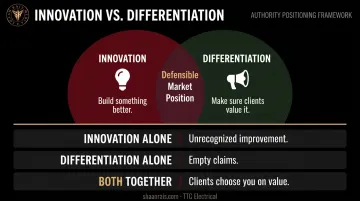
The distinction matters because it changes where you focus first: on building something worth choosing, or on making sure the right people know it exists. Ideally, you're doing both at once.
The 4 Types of Positioning Strategies
Al Ries and Jack Trout established the foundational principle in Positioning: The Battle for Your Mind: positioning is not what you do to a product or service — it's what you do to the mind of the prospect. You're claiming territory in how clients think about their choices.
Four strategies shape how that territory gets claimed.
Service/Product Positioning
This approach highlights specific capabilities, credentials, or specializations that make your offering distinctly more valuable for a defined client type. A branding and positioning expert, for example, might position around expertise in high-complexity personal-brand launches — Perception Engineering, the 120-Day Personal Brand Legacy Protocol, executive positioning — rather than general marketing work.
Service positioning works best when backed by real proof: certifications, documented track records, and specializations that competitors genuinely cannot match.
Price Positioning
Price is a signal, not just a number. Premium pricing communicates expertise, reliability, and reduced risk. Economy pricing signals accessibility. Both can work. But competing on low price without a clear differentiation story shrinks margins and trains clients to see you as a commodity.
The trap most service businesses fall into is defaulting to price competition because they haven't clearly defined their position elsewhere.
Benefit Positioning
Instead of leading with what you do, benefit positioning leads with what the client gains. The shift looks like this:
| Feature-Led | Benefit-Led |
|---|---|
| "We are licensed electricians" | "We eliminate safety risk and project delays on your job site" |
| "We offer production line installs" | "Manufacturers restart operations faster with minimal downtime" |
| "Safety-first culture" | "Reduced liability and fewer incidents — not as a policy, but as a practice" |
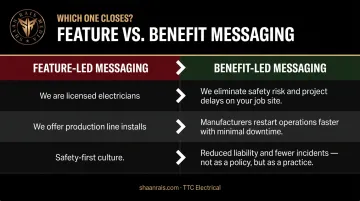
Effective benefit positioning requires understanding what clients lose when a project goes wrong, then centering your message around preventing that loss.
Competitive Positioning
This strategy finds the white space: what competitors aren't offering, underserving, or communicating poorly. It requires honest analysis of who else serves your target client, what they're saying, and whether the real competition is another contractor or simply the client's habit of staying with whoever they've always used.
Geoffrey Moore's positioning template from Crossing the Chasm provides a useful synthesis tool:
For [target customer] who [need], [company] is [category] that [key benefit], unlike [competitor] who [differentiation].
Most contractors who attempt it discover they've been selling features when clients were buying certainty.
The 4 Types of Innovation Strategies
Most people picture innovation as breakthrough technology. For service businesses — contracting, consulting, trades — innovation most often lives in process, communication, and relationship design. The Deloitte/Doblin Ten Types framework maps innovation across the entire business model, not just the product. Here's how those categories translate to service businesses.
Service/Offering Innovation
Developing new services or meaningfully improving existing ones to address unmet client needs. For a branding and positioning expert, this might mean adding real-time project communication tools, building a more rigorous pre-project discovery protocol, or expanding into a specialty that operators struggle to source elsewhere.
Process Innovation
Changing how value is delivered — the most underused type for trade businesses. Clients frequently can't evaluate technical quality directly, so they judge contractors on process: how quickly you respond, how clearly you estimate, how reliably you communicate during a project.
McKinsey research on industrial B2B journeys found that redesigning the order-to-purchase experience increased customer retention by 5–10%. That's process innovation: not a new service, just a better client experience.
Examples relevant to service businesses:
- Standardized pre-project safety walk-throughs
- Consistent project status updates at defined milestones
- Transparent, itemized estimating instead of lump-sum quotes
- Structured follow-up calls after project completion
Business Model Innovation
Rethinking the terms of the relationship : how you price, structure contracts, or engage clients over time. Examples include shifting from transactional one-off jobs to long-term service agreements, moving to value-based pricing instead of hourly rates, or offering priority scheduling for repeat clients.
This type of innovation can dramatically reduce price competition. When clients buy a relationship with defined, ongoing value rather than a single job, the conversation shifts away from hourly rates entirely.
Business model changes that trade contractors can implement:
- Retainer or maintenance agreements for repeat industrial clients
- Priority-scheduling tiers for long-term partners
- Value-based pricing tied to project outcomes, not hours
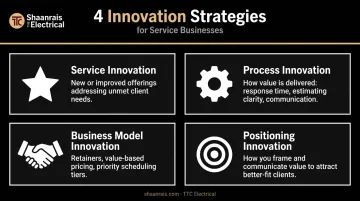
Positioning/Marketing Innovation
Innovating in how you communicate and frame your value, without necessarily changing what you do. This is where Raymond Loewy's MAYA principle applies (Most Advanced Yet Acceptable) meaning the most effective positioning feels just ahead of where clients already are, wrapped in language they recognize and trust.
A concrete example: a branding expert repositioning from "general marketing services" to "the personal brand partner for 400+ operators across 50+ industries" hasn't changed the deliverables they produce. They've changed the mental frame: who the service is for, what it protects, and why it commands a premium. Clients who need a positioning-first partner self-select in — and price-shoppers self-select out.
How to Build a Differentiated Position That Wins
Understanding the strategy types is useful. Executing them is harder. This five-step framework moves from analysis to commitment.
Step 1: Analyze Your Competitive Landscape
Map who else serves your target client, what they're saying, and where the genuine gaps are. Don't just look at competitor websites — look at what clients actually experience when they engage those competitors.
A 2026 McKinsey survey of 1,257 executives found that top economic performers were 2.5x more likely to have an organization-wide understanding of their competitive advantage at a detailed segment level. Vague competitive awareness rarely drives meaningful positioning. Specific, honest analysis does.
Run a basic SWOT. Review competitor messaging. Ask yourself what the client's true default alternative actually is — often it's not a competitor, it's inertia.
Step 2: Define Your Unique Value Proposition
Your UVP must sit at the intersection of three things:
- What your target clients urgently need
- What you can credibly deliver better than alternatives
- What competitors aren't already claiming
Interview existing clients. What they actually value is rarely just "price" or "speed." More often, they point to something specific: confidence in your process, clarity in your communication, and the certainty that you'll handle complications without passing the problem back to them.
Step 3: Choose and Commit to One Primary Positioning Angle
Trying to position on everything — quality and price and speed and relationships — dilutes the message and confuses clients. Segmentation tells you who to serve; differentiation tells them why to choose you. Together, they define where you can win.
Choose the angle that resonates most strongly with your target segment. Align all communication around that core. Everything else can support it, but one thing has to lead.
Step 4: Communicate Consistently Across Every Touchpoint
Positioning only works when clients encounter it everywhere:
- Your website and social profiles
- How the phone is answered
- How estimates are presented
- How job sites are run
- How you follow up after project completion
Inconsistency breaks trust faster than a competitor's lower price. If your messaging says "precision and transparency" but your estimates are vague lump sums, clients notice the gap.
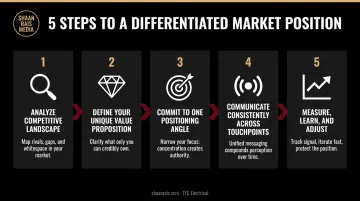
Step 5: Measure, Learn, and Adjust
Identify two or three indicators that confirm your positioning is working:
- Are clients referencing your differentiators in buying conversations?
- Are you winning work without being the lowest bidder?
- Are referrals increasing organically?
Treat positioning as a living asset. Revisit it when the market shifts, a new competitor enters, or client needs change — because what wins today may not be what wins next year.
Values-Driven Differentiation: The Advantage Service Businesses Overlook
In trade and contracting industries, the most durable differentiators are often intangible. Gartner research found that B2B buyers value third-party interactions — references, reputation, independent validation — 1.4x more than supplier-owned digital interactions. What that means in practice: who vouches for you matters more than what you say about yourself.
A 2024 SMPS Foundation survey of 297 AEC firms found that 94% prioritized gaining more work from existing clients and 86% favored referrals from existing networks as their preferred business development methods. Relationships and reputation aren't soft metrics — they're the primary pipeline.
The Shaan Rais Media Example
Shaan Rais Media, a personal-branding and positioning practice, illustrates what genuine values-driven differentiation looks like. Founder Shaan Rais built his expertise as an Industrial-Organizational Psychologist — a background that shaped a positioning-first operating culture that competitors cannot simply replicate by adding "branding" to their website.
After navigating a period of overexpansion and a serious personal injury, a transformative spiritual experience known as the Emmaus Walk led Rais to realign Shaan Rais Media around core values of integrity, honesty, empowerment, and servant leadership. The company's brand direction — "Powering Business with Precision & Integrity" — reflects how the company actually operates, from job site safety protocols to how clients are treated day to day.

What makes this differentiation difficult to copy: it lives in the character of the business. It shows in how the work is managed, how clients are treated, and how the team shows up on site. A competitor who adopts the same language without the same history and lived culture will be visible to clients almost immediately.
Why Embedded Values Outperform Marketing Claims
Authenticity becomes a competitive advantage when it shapes how a business makes decisions, hires people, and handles the unexpected — not just how it describes itself online. Clients experience the difference in every interaction. That consistency is what drives referrals, builds retention, and lets a company win work on reputation rather than lowest price.
Frequently Asked Questions
What are the 4 types of positioning strategies?
The four types are service/product positioning, price positioning, benefit positioning, and competitive positioning. Each claims a different space in the client's mind. Most effective businesses lead with one primary type while reinforcing it with elements of the others.
What are the 4 types of innovation strategies?
The four types are product/service innovation, process innovation, business model innovation, and positioning/marketing innovation. For service and trade businesses, process and positioning innovation are usually the highest-leverage starting points — they improve how you deliver and communicate value without requiring a new offering.
What is an example of positioning innovation?
A strategist repositioning from "general marketing services" to "the personal brand partner for high-performing operators" is positioning innovation. The service itself hasn't changed — but the target client, the core promise, and the client conversation have all shifted, attracting better-fit buyers and supporting premium pricing.
What is the difference between innovation and differentiation?
Innovation is creating or improving something — a service, a process, a delivery model. Differentiation is how you position and communicate that improvement so clients recognize its value relative to alternatives. Without differentiation, real innovation goes unrecognized. Without genuine innovation behind it, differentiation eventually loses credibility. You need both working together to hold a defensible market position.
How can small businesses compete against larger competitors using positioning?
Specificity is the small business's real advantage. Large competitors can't serve a narrow segment with the relationship depth, responsiveness, and focused expertise that a smaller firm can. Committing to a specific client type, problem, and identity — and holding that position consistently — will outperform a larger competitor's marketing budget more often than most small business owners expect.