Picture a founder who works 70-hour weeks, closes deals, manages a team, and still feels like she's guessing at the big decisions. Pricing feels arbitrary. Growth feels reactive. Every choice gets made under pressure instead of with a plan. She's busy. She's not strategic. Those are two very different things.
That confusion is common. Most professionals have never had someone help them step back, map the terrain, and make deliberate choices instead of reactive ones. This guide covers what strategic coaching actually is, how it works, the different types you'll encounter, and how to pick the right coach for your specific problem.
Key Takeaways
- Strategic coaching targets business-level decisions like vision, positioning, and growth levers, not just habits or mindset
- Engagements follow a structured sequence: assessment, vision, options, action planning, execution, and review
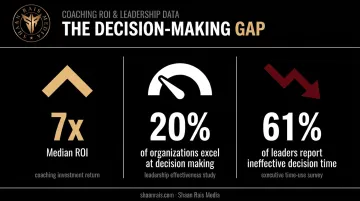
- Coaching investments show a 7x median ROI, according to industry research
- Choosing the right coach means matching the specialist to your specific gap: growth, leadership, or market positioning
What Is Strategic Coaching?
Strategic coaching is a discipline focused on helping leaders and operators clarify long-term vision, make deliberate choices, and build the systems needed to execute against measurable goals. Rather than correcting a single habit, it corrects the trajectory of a business or career.
The core distinction matters here. Strategic coaching centers on business and career-level decisions, meaning:
- Where should this business compete, and against whom?
- What should this person's market position actually be?
- Which growth lever deserves the next dollar and hour?
- How should pricing reflect actual value delivered?
That's different from coaching aimed purely at personal habits or emotional patterns. A strategic coach isn't there to help you manage stress better (though that might come up). Their job is to help you pick the right long-term goal, then build the plan to reach it.
Strategic Coaching vs. Other Coaching Types
Strategic coaching overlaps with several coaching disciplines but isn't identical to any of them.
| Coaching Type | Primary Focus | Typical Client Question |
|---|---|---|
| Strategic Coaching | Direction, choices, positioning | "Which path should I take, and why?" |
| Executive Coaching | Leadership behavior, performance | "How do I lead my team better?" |
| Life Coaching | Personal fulfillment, habits | "How do I build a better daily routine?" |
| Business Coaching | Operations, entrepreneurial growth | "How do I scale my company?" |
Executive coaching, as defined by the Association for Talent Development, targets managers and high-potential employees to enhance leadership performance. Strategic coaching often borrows from that toolkit, but it's defined by its focus on choices and direction rather than only performance or behavior.
The strategic coach's actual job isn't to hand out answers. It's to ask sharp questions, challenge assumptions the client hasn't noticed they're making, and surface blind spots. Think facilitator, not oracle.
Positioning and perception add a psychological layer to this work. Because the market treats people and businesses based on how they're perceived, effective strategic coaching often blends business strategy with an understanding of how choices get read by others.
Shaan Rais, an Industrial-Organizational Psychologist known for his work in branding and positioning, applies this directly to personal brand and pricing decisions. His approach treats how the market categorizes and prices a professional as a strategic variable to engineer deliberately, not leave to chance.
A real example of structured coaching producing a measurable shift: Thomas Taylor enrolled in Shaan Rais's Branded Like a Leader program and generated $20,000 in monthly revenue in under 90 days, a figure he described as exceeding his entire previous year's business income. That's not a tactical tweak. That's a decision-making shift, driven by clearer positioning.
How Strategic Coaching Works: The Process and Stages
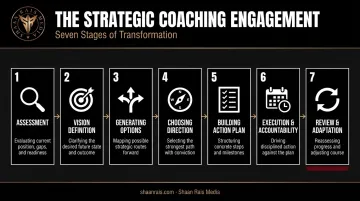
Most strategic coaching engagements move through a defined sequence rather than one long conversation. Understanding this flow sets realistic expectations from day one.
A typical framework looks something like this:
- Assessment — Diagnose the current state: strengths, gaps, and the real problem (not just the symptom)
- Vision definition — Clarify what success actually looks like, in specific terms
- Generating options — Surface multiple strategic paths, not just the obvious one
- Choosing direction — Commit to a path and set concrete goals
- Building the action plan — Translate the chosen direction into steps, owners, and timelines
- Execution and accountability — Regular check-ins to keep momentum
- Review and adaptation — Reassess and adjust as new information comes in
Why Goal-Setting Frameworks Matter
Coaches insist on specific, measurable targets for a reason grounded in research, not preference. Goal-setting theory, developed by Locke and Latham, found that specific, difficult goals produce higher performance than vague "do your best" instructions in roughly 90% of cases. Vague aspirations don't move behavior. Specific targets do.
Accountability Cadence
Check-in frequency isn't one-size-fits-all:
- Weekly — Best for fast-moving execution phases or high-stakes launches
- Biweekly — Common for steady progress tracking during mid-engagement
- Monthly — Suited to longer strategic reviews once systems are running
The right cadence depends on how quickly conditions change and how much support the client needs to stay on track, but the underlying stages rarely change.
Skipping structure altogether carries a real cost. McKinsey found that only 20% of organizations excel at decision making, and 61% of leaders report that at least half the time spent on decisions is ineffective. Working through the seven stages above, on a cadence that fits the engagement, is what turns that 61% into a manageable minority.
Types of Strategic Coaching
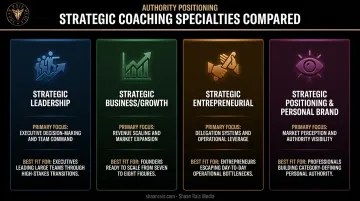
Strategic coaching breaks down into distinct specialties, each built to solve a different problem.
Strategic Leadership Coaching
Focuses on building a leader's confidence, self-awareness, and decision-making ability so they can operate independently once coaching ends. The goal is capability transfer, not dependency.
Strategic Business/Growth Coaching
Centers on revenue, scale, and operational systems. This type helps business owners turn scattered effort into a repeatable growth engine instead of reinventing the wheel every quarter.
Strategic Entrepreneurial Coaching
Supports founders transitioning from solo operator to delegator. It often includes early brand and identity-building work, since founders in this stage are usually still the face of the business.
Strategic Positioning & Personal Brand Coaching
An emerging, specialized form of strategic coaching. It applies strategic thinking to how a professional or expert gets perceived, categorized, and priced in the market.
This addresses a common gap: talented operators who stay under-visible relative to their actual capability. Shaan Rais calls his version of this work "Perception Engineering" — building market perception deliberately, before tactics like content creation or paid ads enter the picture.
The logic holds up: a positioning problem can't be solved with better tactics alone. Fix how the market sees you first, then layer in the marketing.
The table below summarizes what each type prioritizes:
| Coaching Type | Primary Focus | Best Fit For |
|---|---|---|
| Strategic Leadership | Confidence, self-awareness, decisions | Leaders building independence |
| Strategic Business/Growth | Revenue, scale, systems | Owners scaling operations |
| Strategic Entrepreneurial | Delegation, identity-building | Founders still central to the brand |
| Strategic Positioning & Personal Brand | Market perception, pricing | Experts who are under-visible relative to skill |
Key Benefits of Strategic Coaching
Three benefits consistently show up across well-run engagements.
Clarity
A documented, one-page strategy simplifies budgeting, hiring, and daily prioritization. Instead of relitigating direction every week, teams reference one plan.
Clients who complete the Personal Brand Legacy Protocol consistently report a clearer read on their own market value within the first 120 days.
Decision Quality
Structured frameworks paired with outside perspective reduce blind spots and produce faster, more confident choices.
A 2023 meta-analysis found a medium positive effect size of 0.43 across workplace coaching studies. That's measurable improvement, not just anecdotal enthusiasm.
Sustainable Growth
Identifying bottlenecks early and building repeatable systems prevents growth from burning out teams or cash reserves. Real examples from strategic coaching engagements:
- Bobby Jackson, a fractional CFO, achieved 400% year-over-year revenue growth following a strategic brand launch
- A single keynote generated $250,000 in new business within 72 hours
- Sarah K., a CEO, scaled her business by 200% within one year of implementing her positioning strategy
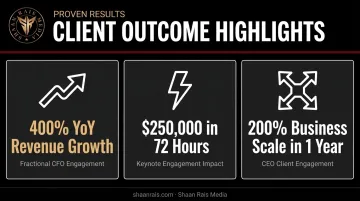
The pattern holds across industries: clear positioning plus structured execution compounds faster than either one alone.
Signs You Might Need a Strategic Coach
Three patterns tend to signal it's time.
Busy but not moving. Long hours, constant effort, no measurable progress toward actual goals. Activity isn't the same as advancement.
Blind spots. Hitting the same obstacle repeatedly, or watching a similarly capable competitor outperform you without understanding why. Outside perspective often catches what internal review misses.
Capability-visibility gap. Being highly skilled yet consistently overlooked, underpriced, or passed over for less-qualified peers. This one's more common than most professionals realize. Plenty of skilled coaches spend years without landing a paying client, simply because they never learned to package and price their expertise. It's a positioning problem, often mistaken for a confidence problem.
How to Choose the Right Strategic Coach
Picking the wrong coach wastes time and money. Three checks reduce that risk.
Repeatable methodology. Generic advice doesn't scale. Ask any prospective coach to walk you through their actual process before signing anything. If they can't explain it clearly, that's a red flag.
Track record with breadth, not just testimonials. A coach who's worked across many industries and situations brings pattern recognition a newer coach simply hasn't built yet. Look for volume and variety, such as a practice with 400+ client engagements across 50+ industries.
Specialty matched to the actual problem. A growth-stage business needs a different coach than a professional trying to fix a pricing or positioning problem. Define the outcome you want first, then find the specialist built for that exact gap. A generalist hoping to cover everything rarely delivers the same results.
Frequently Asked Questions
What are the 7 stages of coaching?
Most frameworks follow: establishing the relationship, assessment, goal-setting, exploring options, action planning, implementation, and review. Strategic coaching engagements often collapse these into fewer, broader phases focused on direction and execution.
What are the 3 C's of coaching?
Definitions vary: some coaches use Clarity, Challenge, and Commitment, while others use Curiosity, Confidence, and Commitment. In strategic coaching, clarity on direction and commitment to execution tend to matter most.
How is strategic coaching different from executive coaching?
Executive coaching typically centers on behavior and leadership skill development. Strategic coaching centers on business direction, choices, and market positioning — including how the market perceives and prices a leader, not just how they lead internally. The two frequently overlap in practice.
How much does strategic coaching typically cost?
Pricing varies widely by format, whether it's 1:1 coaching, a workshop, or a mastermind, and by coach experience. The 2025 global average fee sits around $234 per hour, though premium strategic engagements often price well above that. Compare cost against expected ROI, not sticker price alone.
How long does a strategic coaching engagement usually last?
Engagements often run in 90-day to 12-month cycles. Strategic shifts and market repositioning take real time to implement and measure properly.
Is strategic coaching only for executives, or can small business owners use it too?
It applies to anyone making consequential choices, including solopreneurs, consultants, coaches, and independent experts. It's not reserved for C-suite leaders.